
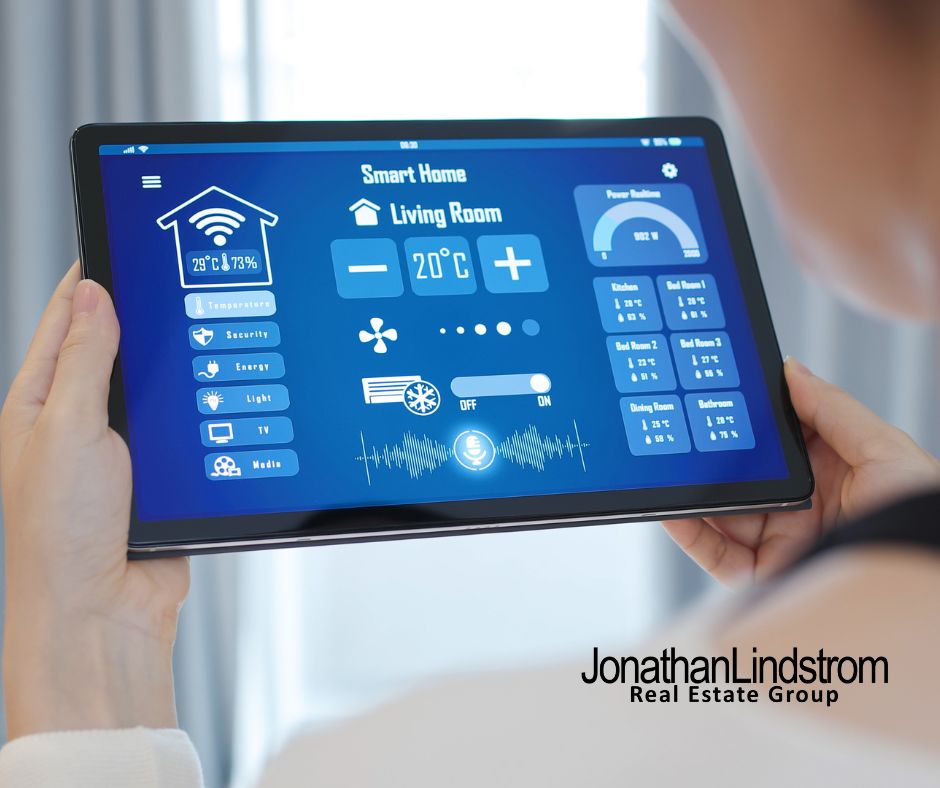
Remember the Jetsons? They were a futuristic cartoon family with their own popular 1960s TV show who introduced us to some high-tech trends like flying cars, robot maids and “push-button Space Age-envisioned conveniences.” While we’re not quite there yet, plenty of “push-button” smart home conveniences have bound onto the market in recent years, helping make homes more comfortable, safe and convenient.
Using smart home technology isn’t a far-fetched goal for homeowners – and there are some good details to know about how different features function, how often buyers are searching for them, and which stay or go when the sale goes through.
Common smart home features
With the right amount of research, motivation and budget, nearly any home can become a smart home. Brandon Doyle, a real estate agent with RE/MAX Results in Maple Grove, Minnesota, explains that a smart home by today’s standard is simply a house with an integrated system of technology.
“The textbook definition of a smart home is three or more connected devices,” says Doyle. “The devices can be connected to each other or to the internet and accessed remotely.”
The technology can vary, but it most commonly includes elements like:
• Voice Assistant – Voice activated software that carries out simple commands, like telling the temperature or shutting off lights. E.g. an Amazon Echo or Google Nest.
• Smart Lock – A Wi-Fi or Bluetooth-enabled door lock that uses the tap of a finger or voice command, allowing homeowners to leave their keys at home.
• Smart Doorbell – Synonymous with video doorbell, this internet-connected device allows a homeowner to see who’s at the front door via a video feed and smart phone.
• Smart Thermostat – Also Wi-Fi enabled, this technology automatically adjusts a home’s heating and cooling settings and can also be adjusted remotely with a smart phone.
• Smart Water Meter – This technology can analyze water usage and track patterns to optimize efficiency. Some are automatic while others can be manually adjusted using a smart phone.
• Smart Garage Door– This Wi-Fi enabled device allows you to remotely check on the state of your garage door, open and shut it, or check when it was last in use.
• Smart Security System – Also known as a Smart Alarm, this is a system of window and door sensors that can be monitored and controlled through a smart phone.
Each of these components serves a modern function, but when connected to a central hub – like a smart phone or voice assistant – they can operate by simple command, becoming much more convenient.
Selling a home in the “Smart Age”
For home sellers, it’s important to know what the expectations are that come with home technology when listing a home for sale. Personal property technology, like a robot vacuum or streaming device that isn’t embedded in the home is considered an item the seller would take with them. But an item such as a smart thermometer, doorbell, smart lock, or security system that requires installation – and therefore can be considered a fixture of the house – will likely stay when it’s time to move.
How buyers feel about smart home technology
Today’s buyers may be used to – or even expecting – a myriad of these digital features in the homes they consider purchasing. And for the homeowners occupying their home before selling, these forms of technology certainly do offer several conveniences and peace of mind. But, smart home technology isn’t necessarily a make-or-break factor for most buyers considering purchasing a home.
While homebuyers may not require a full suite of tools that designate a property a smart home, they might be interested in individual additions. For example, buyers who previously relied on heat from an electrical baseboard system or AC from a window unit may be enamored by the idea of having an updated HVAC system controlled by a tool like a Nest Thermostat.
With their heightened convenience and extra safety measures, real-life smart homes are here to stay.